

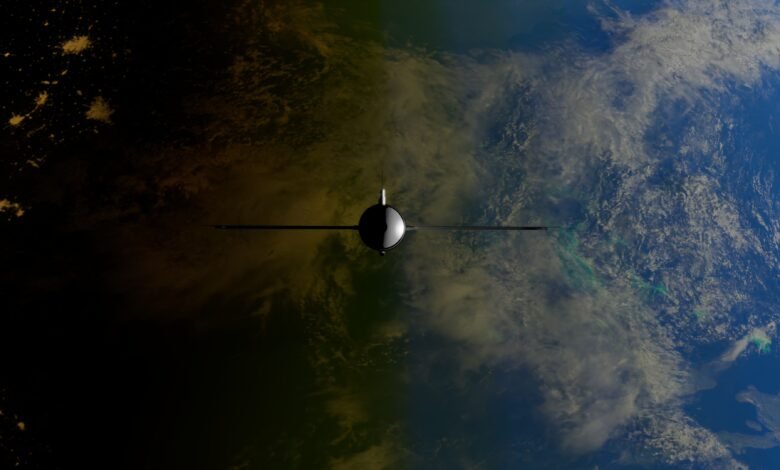
The Titania satellite has entered orbit, giving Britain’s Armed Forces a new pair of eyes in space
Titania is the second satellite in the United Kingdom’s growing military constellation, following Tyche, which launched in 2024. The Ministry of Defence (MoD) confirmed on Saturday 7 November 2026 that the British-built spacecraft had successfully entered orbit, after launching on 1 October 2026 aboard a SpaceX Falcon 9 rocket from California.
Defence Secretary Wes Streeting said the moment marked a shift in how Britain defends itself. “The new space age is here. Space underpins everything from weather forecasts and financial transactions to sat-navs and mobile phone connections, and it is critical for our national security and military operations. Having Titania now in orbit and Project Inaros stepping up how we watch over our satellites means we can see threats sooner, making the UK safer.”
| Titania satellite — quick reference summary | |
|---|---|
| Full name | Titania satellite |
| What it is | UK military observation satellite |
| Programme | ISTARI programme |
| Operator | UK Space Command, RAF High Wycombe |
| Launched | 1 October 2026 |
| Launch vehicle | SpaceX Falcon 9 |
| Launch site | California, USA |
| Confirmed in orbit | 7 November 2026 |
| Mass | Around 100 kg |
| Size | About the size of a washing machine |
| Speed | 27,000 kilometres per hour |
| Orbit time | 90 minutes |
| Orbit type | Sun-synchronous orbit |
| Designed and built | Hampshire, UK |
| Contract | £9.5 million |
| Previous satellite | Tyche (launched 2024) |
| Next satellites | Juno and Oberon |
| Full constellation target | End of 2033 |
| Defence space investment | More than £3 billion over four years |
| Defence spending target | 3% of GDP by 2030 |
| Ground sensors | Project Inaros (UK, Australia, Cyprus) |
What Titania was built to watch
Titania’s job is observation. From its orbit, the satellite will image military activity on Earth and feed that information back to UK Space Command, headquartered at RAF High Wycombe. The aim is to give commanders better information for planning and coordinating operations, rather than relying on imagery supplied by allies.
That matters because Britain has historically relied heavily on allies, above all the United States, for space-based intelligence. Titania, together with the satellites that follow it, is intended to reduce that dependence and give the UK a sovereign capability. The GOV.UK announcement sets out the programme’s scope, while Sky News reported the satellite’s speed and orbit figures on the morning of the announcement.
The Ministry has not said how often Titania can image any particular place, and that detail depends on its orbit. What it has confirmed is that the satellite is now in orbit as part of the ISTARI programme.
A washing-machine-sized satellite travelling at 27,000 kilometres per hour
For a military asset, Titania is strikingly small. At around 100 kg and roughly the size of a washing machine, it is far lighter than the large reconnaissance satellites of previous generations. Its compact design reflects a broader shift towards smaller, cheaper spacecraft that can be launched more frequently and replaced more easily.
Its speed is equally stark. Travelling at 27,000 kilometres per hour, Titania completes a full orbit of Earth every 90 minutes in a sun-synchronous orbit — an orbit that keeps it passing over the same parts of the planet at the same local solar time, which helps with consistent imaging conditions.
The launch itself used a reusable SpaceX Falcon 9 rocket, lifting off from California on 1 October 2026.
Hampshire-built, British-funded: who made Titania and what it cost
Titania was designed and built in Hampshire through a partnership between the Defence Science and Technology Laboratory (Dstl) and BAE Systems. The £9.5 million contract covered the design and build of the satellite, which was assembled in the UK.
The Hampshire build matters to the Ministry’s wider argument. Titania and Project Inaros are British-built capabilities, and the government has presented them as evidence that defence investment can support jobs and skills at home, as well as military capability.
That industrial thread runs through the funding as well. The satellites and the sensor project sit inside more than £3 billion of defence space investment over four years, announced alongside Titania. The government has also committed to a defence spending target of 3% of GDP by 2030 set out in the October Budget.
Project Inaros: the ground network watching over Titania
Titania’s announcement came with a second project that looks in the opposite direction. Project Inaros is a trial network of advanced ground sensors at sites in the United Kingdom, Australia and Cyprus, designed to monitor activity in space and detect threats to UK satellites.
The sensors are neuromorphic optical devices, a newer type of sensor designed to spot faint or fast-moving objects in space. Unlike Titania, which looks down at Earth, Inaros looks up — watching for other satellites, debris and potential threats to Britain’s growing constellation.
The pairing reflects a shift in defence thinking. Satellites were once treated mainly as tools for looking at Earth. Now, with more countries operating in orbit, the UK is also investing in ways to protect its own satellites from interference or attack.
What comes next for Britain’s satellite constellation
With Titania in orbit, the constellation stands at two satellites. Juno and Oberon are the named successors, and the ISTARI programme’s goal is a full space-based intelligence, surveillance and reconnaissance capability by the end of 2033. No launch dates for Juno or Oberon have been given, so the pace of that build-up remains the open question for the programme.
The funding is the other open question. More than £3 billion over four years is a substantial commitment, but it covers the wider space portfolio, not Titania alone, and the detailed year-by-year spending path will be tested at future spending reviews. What is not in doubt is the direction of travel: Britain now has two of its own military observation satellites in orbit, built at home, operated from RAF High Wycombe, and backed by a ground network watching over them.
For readers watching the skies this month for a different reason, the Taurid meteor shower peaks on the night of 11–12 November, offering a view of space debris burning up naturally, a long way below Titania’s orbit.
Frequently asked questions
When was the Titania satellite launched?
Titania launched on 1 October 2026 aboard a SpaceX Falcon 9 rocket from California, according to the Satcat orbital catalogue. The Ministry of Defence confirmed on 7 November 2026 that it had successfully entered orbit.
What does Titania do?
Titania is a military observation satellite. It images military activity on Earth from space, giving the UK Armed Forces better information for planning and coordinating operations.
How big is Titania and how fast does it travel?
Titania weighs around 100 kg, about the size of a washing machine. It travels at 27,000 kilometres per hour and completes one orbit of Earth every 90 minutes.
What is the ISTARI programme?
ISTARI stands for Intelligence, Surveillance, Target Acquisition and Reconnaissance Information. It is the programme building Britain’s constellation of military satellites and ground systems, aiming to deliver space-based intelligence, surveillance and reconnaissance capabilities by the end of 2033.
What is Project Inaros?
Project Inaros is a trial network of advanced ground sensors at sites in the United Kingdom, Australia and Cyprus, designed to monitor activity in space and detect threats to UK satellites.
Myth check: is Titania a space weapon?
the claim that Titania is a space weapon is not supported by anything the Ministry of Defence has published. Titania is described as an observation and reconnaissance satellite, and its stated role is imaging military activity on Earth, not attacking targets in orbit. Equally, the idea that it can watch any place on Earth at any moment is not supported: the Ministry has given no imaging schedule, and how often a satellite can observe a location depends on its orbit.





One Comment